A Napoleon III period cartel clock, circa 1860, featuring an architectural design inspired by the Louis XIV and Régence styles. The case is entirely clad in Boulle marquetry combining tortoiseshell and gilt brass, and is lavishly adorned with finely chased gilt-bronze mounts.
The upper section is topped by a curved, four-sided concave hood, surmounted by a flame-shaped finial. The moldings are accented with egg-and-dart and bead-and-reel friezes, while the panels feature marquetry designs of scrolling foliage, arabesques, palmettes, and floral motifs. The side scrolls terminate in large gilt-bronze volute brackets, extending downwards into acanthus leaf pendants. The front is dominated by a circular white enamel dial, encircled by a beaded gilt-bronze bezel. The hours are marked in blue Roman numerals, complemented by an outer minute track in Arabic numerals. The openwork gilt-bronze hands feature elegant scrollwork decoration. The dial is framed by rich Boulle marquetry with symmetrical foliate motifs. Above it sits a gilt-bronze female *mascaron* (mask), surrounded by acanthus scrolls and flanked by two finely chased lion heads.
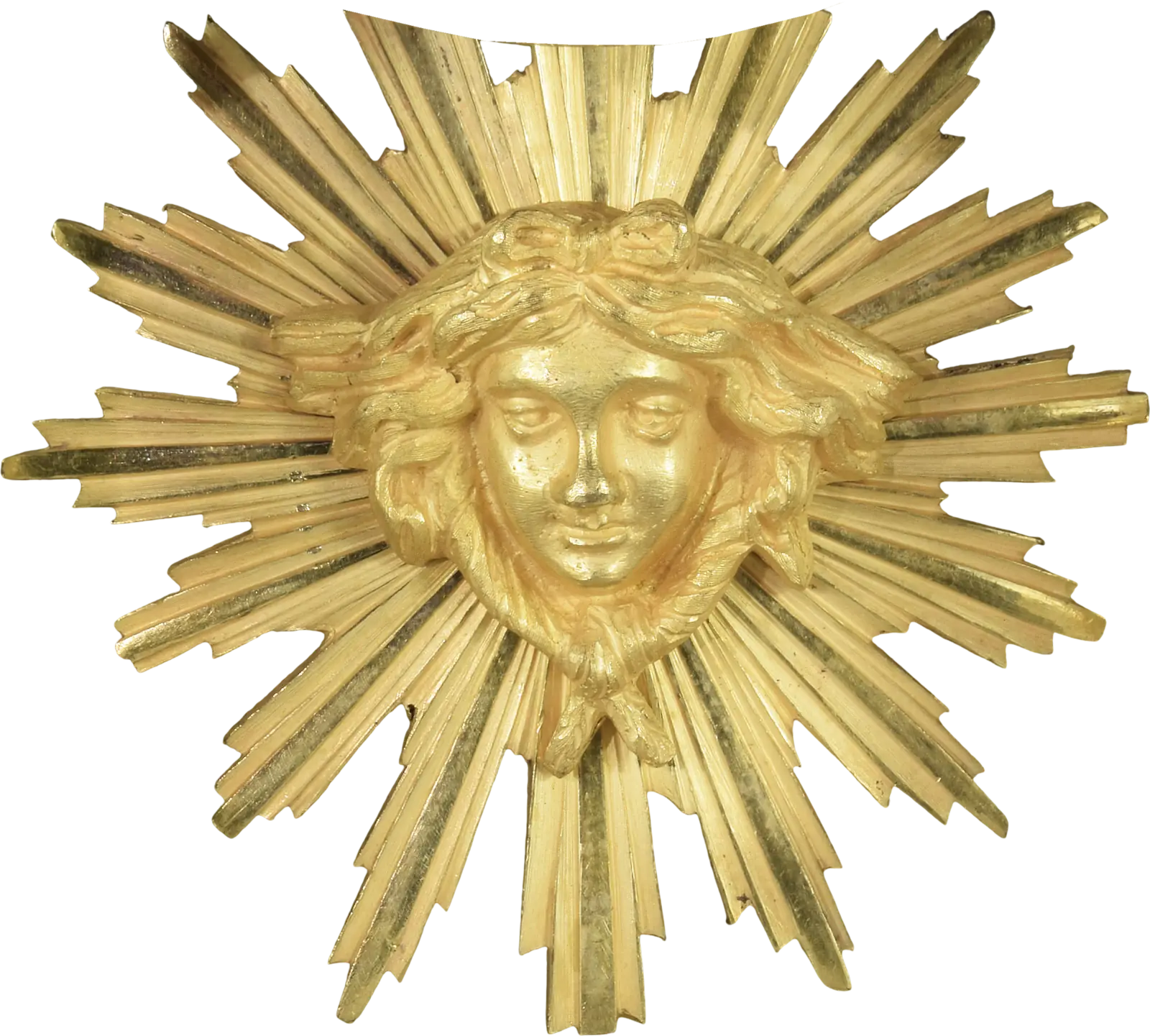
The central section is open to reveal the pendulum, which consists of a gilt-bronze disc depicting a radiant face evoking the Sun. Below, a large openwork cartouche displays a second female *mascaron* topped by a radiant palmette and surrounded by leafy scrolls. The lower rail features Boulle marquetry with arabesques, scrolling foliage, and a central gilt-bronze shell motif.
The sides are embellished with openwork panels featuring a repeating gilt-brass design set against tortoiseshell, framed by twisted gilt-bronze moldings. The contoured…
A Napoleon III period cartel clock, circa 1860, featuring an architectural design inspired by the Louis XIV and Régence styles. The case is entirely clad in Boulle marquetry combining tortoiseshell and gilt brass, and is lavishly adorned with finely chased gilt-bronze mounts.
The upper section is topped by a curved, four-sided concave hood, surmounted by a flame-shaped finial. The moldings are accented with egg-and-dart and bead-and-reel friezes, while the panels feature marquetry designs of scrolling foliage, arabesques, palmettes, and floral motifs. The side scrolls terminate in large gilt-bronze volute brackets, extending downwards into acanthus leaf pendants. The front is dominated by a circular white enamel dial, encircled by a beaded gilt-bronze bezel. The hours are marked in blue Roman numerals, complemented by an outer minute track in Arabic numerals. The openwork gilt-bronze hands feature elegant scrollwork decoration. The dial is framed by rich Boulle marquetry with symmetrical foliate motifs. Above it sits a gilt-bronze female *mascaron* (mask), surrounded by acanthus scrolls and flanked by two finely chased lion heads.
The central section is open to reveal the pendulum, which consists of a gilt-bronze disc depicting a radiant face evoking the Sun. Below, a large openwork cartouche displays a second female *mascaron* topped by a radiant palmette and surrounded by leafy scrolls. The lower rail features Boulle marquetry with arabesques, scrolling foliage, and a central gilt-bronze shell motif.
The sides are embellished with openwork panels featuring a repeating gilt-brass design set against tortoiseshell, framed by twisted gilt-bronze moldings. The contoured base features the same Boulle marquetry and is reinforced at the corners by substantial gilt-bronze mounts decorated with foliage and scrolls. The piece rests on four elegant, curved gilt-bronze feet.
L’arrière s’ouvre par une porte donnant accès au mouvement logé dans la caisse, tandis que le balancier solaire oscille librement dans l’ouverture centrale.
The back opens via a door providing access to the movement housed within the case, while the sunburst pendulum swings freely within the central opening.
The marquetry has been finished with a traditional French polish, highlighting the depth of the tortoiseshell and the luster of the brass, while providing durable protection, a rich sheen, and striking contrast. Complemented by lavish gilt-bronze ornamentation, it stands as a remarkable example of the cabinetmaking and clockmaking craftsmanship of the Napoleon III era, circa 1860.
Original mechanism intact and unmodified. Strikes the hours and half-hours on an antique bell with a clear, authentic tone.
This website uses cookies to ensure you get the best experience on our website.
Functional Always active
The technical storage or access is strictly necessary for the legitimate interest purpose of enabling the use of a specific service explicitly requested by the subscriber or user, or for the sole purpose of carrying out the transmission of a communication over an electronic communications network.
Preferences
The technical storage or access is necessary for the legitimate purpose of storing preferences that are not requested by the subscriber or user.
Statistiques
The technical storage or access that is used exclusively for statistical purposes.Le stockage ou l’accès technique qui est utilisé exclusivement à des fins statistiques anonymes. En l’absence d’une assignation à comparaître, d’une conformité volontaire de la part de votre fournisseur d’accès à internet ou d’enregistrements supplémentaires provenant d’un tiers, les informations stockées ou extraites à cette seule fin ne peuvent généralement pas être utilisées pour vous identifier.
Marketing
The technical storage or access is required to create user profiles in order to send advertising, or to track the user on a website or across several websites for similar marketing purposes.

 Discover this piece
 Discover this piece
 Discover this piece
 Discover this piece
 Discover this piece
 Discover this piece
 Discover this piece
 Discover this piece
 Discover this piece
 Discover this piece
 Discover this piece
 Discover this piece
 Discover this piece
 Discover this piece
 Discover this piece