
Antique clocks have been my whole life…

I was born in 1987 and grew up to the ticking and chiming of the antique clocks my parents, both clockmakers themselves, offered for sale. I grew up among these pieces, surrounded by their mechanisms, their ornament and their history. Day by day they trained my eye, preparing me, long before I knew it, for the craft that would become my own.

After my BTS studies in mechanical engineering, I joined the family workshop as an apprentice. There I was fortunate enough to learn a craft passed on with patience and to receive a training as rare as it was fascinating. In the course of my apprenticeship I discovered much more than a trade. I discovered the pleasure of understanding, preserving and bringing a part of our heritage back to life.

Even today, I marvel at the skill of the craftspeople who made these pieces nearly two hundred years ago. Clockmakers, bronze workers, founders, gilders, enamellers, cabinetmakers… Each brought a mastery of their craft to works whose refinement and quality continue to astonish me. The scale of their production is just as remarkable. Their work has passed from one generation to the next, and careful reconditioning still reveals a beauty that bears witness to the excellence of its making.
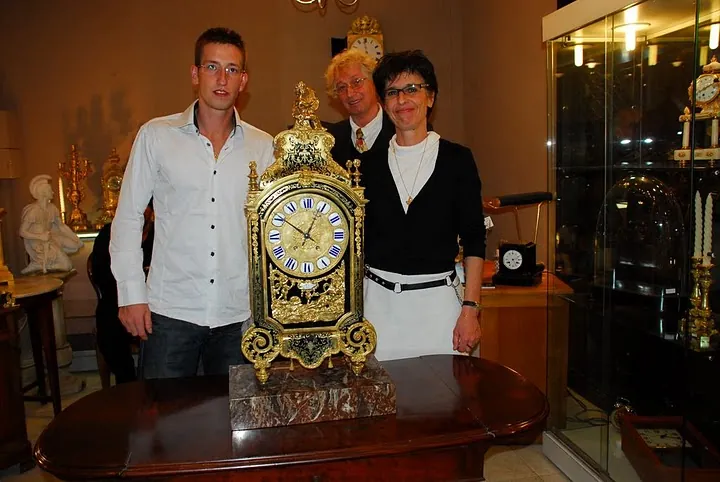
Family photograph from 2006, gathered around an antique clock
Family photograph / 2006
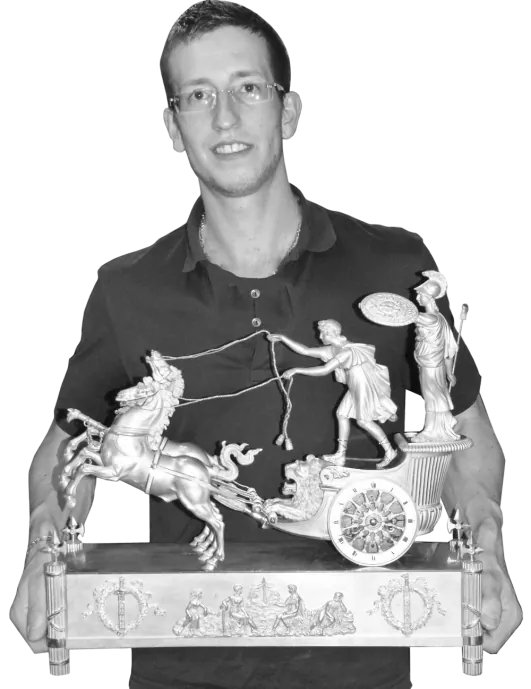
Portrait from 2012 with a chariot clock
2012

Over the years, my eye has grown more discerning and my standards more exacting. I select each piece carefully for its authenticity, the quality of its workmanship and the condition of its original materials. It then undergoes thorough reconditioning that respects its design, ornament and history. My aim is to reveal its full beauty without changing its form or compromising its character.

Offering antiques prepared in this way takes a considerable investment of time and effort, the extent of which is not always apparent at first glance. Finding and selecting each piece is only the beginning. There is the work at the bench, the presentation, the conversations with each client and the meticulous preparation for shipping. Each acquisition is the culmination of a long process that I personally oversee at every stage.

To achieve this result, I take each object completely apart so that every component can be cleaned individually and thoroughly. I give the movement the same attention: dismantling, cleaning and a full overhaul, including rebushing and polishing the pivots when its condition calls for it. The care given to the mechanical parts matters just as much as the care given to the appearance of the piece.

Each material also receives a treatment suited to its nature and finish: French polishing to bring out the depth of marquetry, wax to enhance the lustre of marble and protect it… Every gesture serves the same purpose: to recover the beauty of the object while preserving what gives it its character and authenticity.

After twenty years in the trade, my passion is undiminished. It is there in the care I give to every detail, in my insistence on quality and in the personal attention I offer you. My ambition is to offer you remarkable pieces, prepared with the utmost care, and a service worthy of the trust you place in me.

Beyond the pleasure of acquiring a beautiful object, I hope to share with you a little of the wonder I have felt since childhood.

From the outset, I have sold the antique clocks and works of art I recondition by mail order, in France, across Europe and internationally. Over the years, I have gained considerable experience in shipping these delicate pieces. Each object is securely packed to suit its dimensions, materials and fragility, so that it travels under the best possible conditions.

My support continues after delivery. When you are ready to set up your clock, I guide you step by step with an explanatory video and a live telephone conversation. You have personal assistance for the initial adjustments, so you can make them with confidence and fully enjoy your acquisition.

From preparing your order to getting your clock running, I personally attend to every detail with one constant commitment: to guarantee you a perfect transaction.

Map of France with a red dot marking the workshop in Lyon

Our workshop

Lyon, France

Contact us

Behind the scenes in the workshop

The secrets of an antique clock

From dismantling the clock to uncovering the lustre of its gilding, discover the stages of reconditioning and the ingenuity of its makers.

Just over 200 years ago

A work of ingenuity

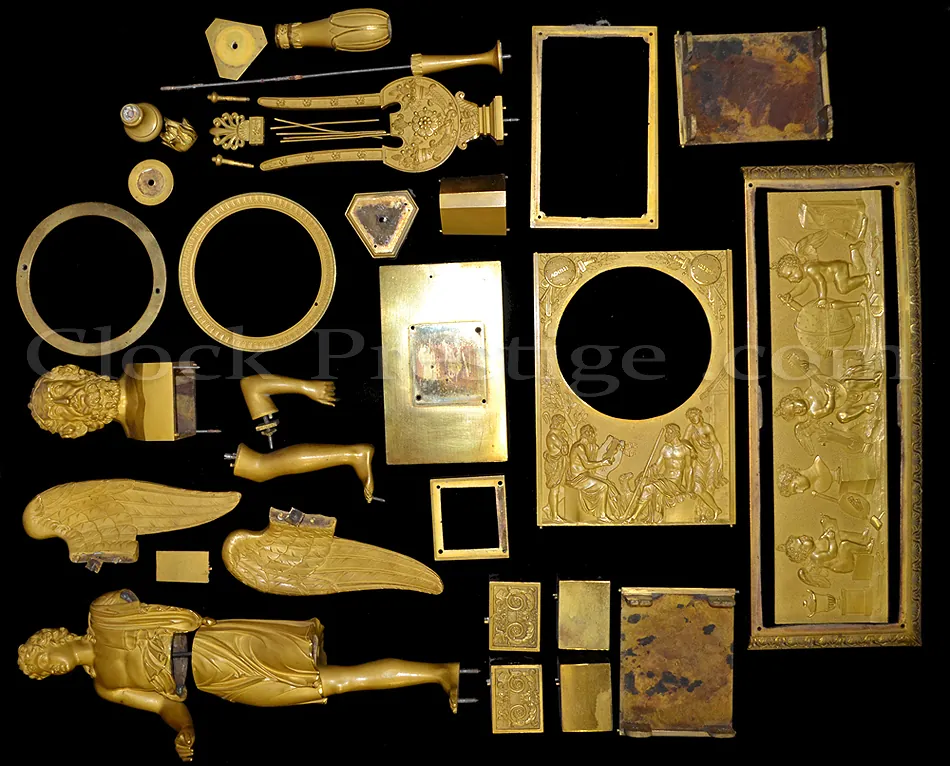
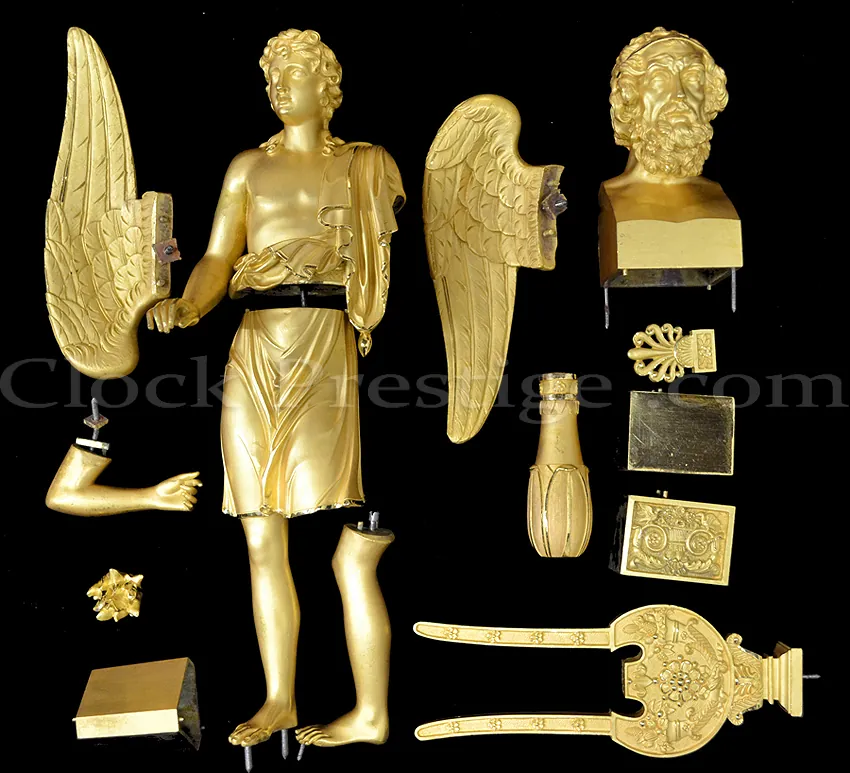
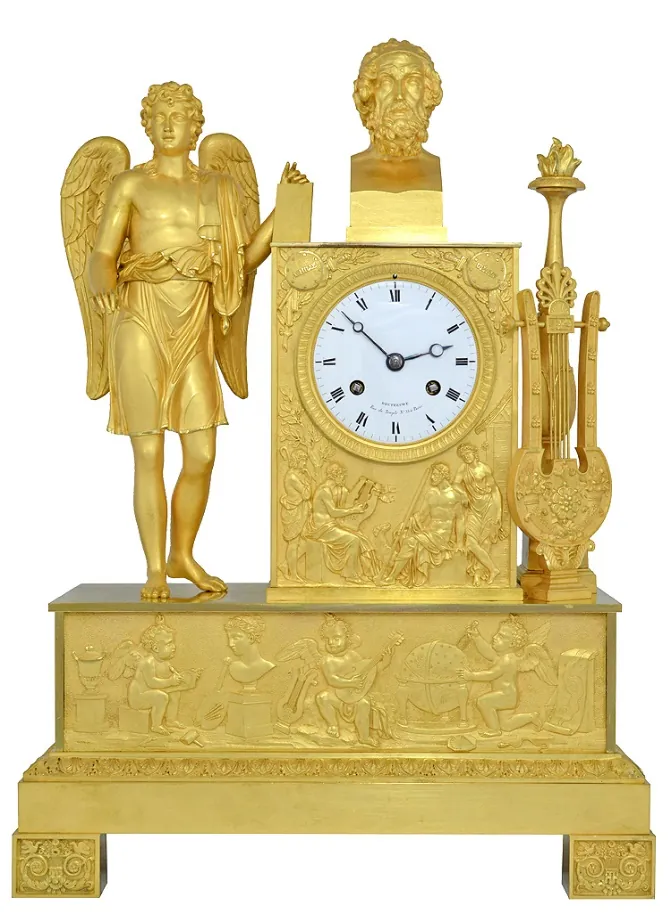
Just over two hundred years ago, bronze workers were already making objects of remarkable complexity without the means we have today. This clock is a fine example: behind its elegant silhouette lies a structure of great precision.

At first glance, it looks like a single block or, at most, an assembly of a few parts. Taking it apart reveals a far more ingenious construction.

The first step

Taking it apart to understand it

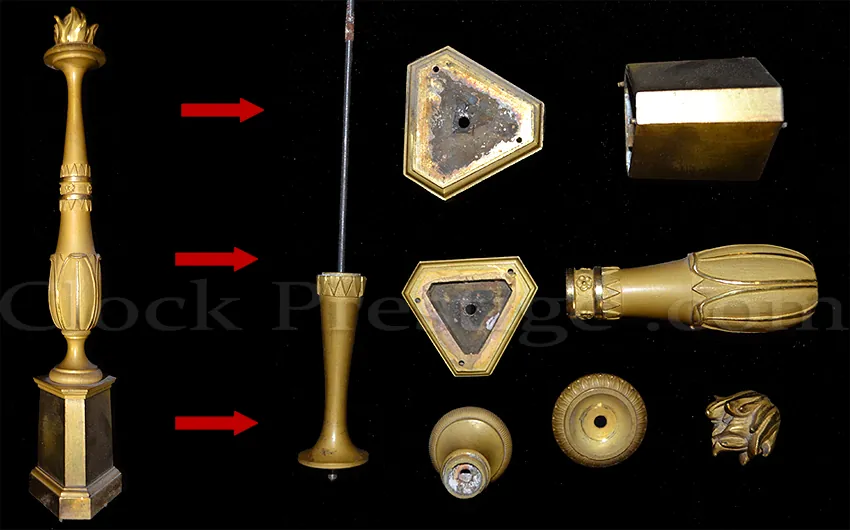
For a thorough reconditioning, we always dismantle the piece completely before cleaning the gilding. Each component is separated so that we can reach even the most concealed areas and work with the necessary precision.

The construction of the base

Precision joints

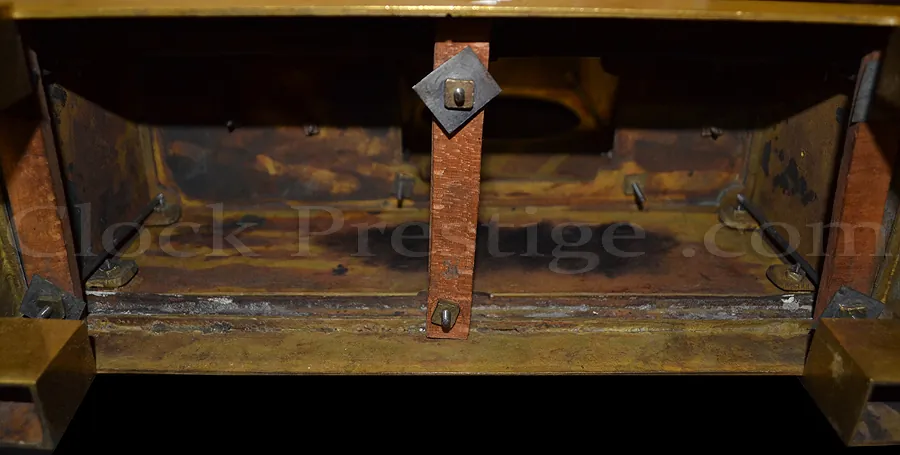
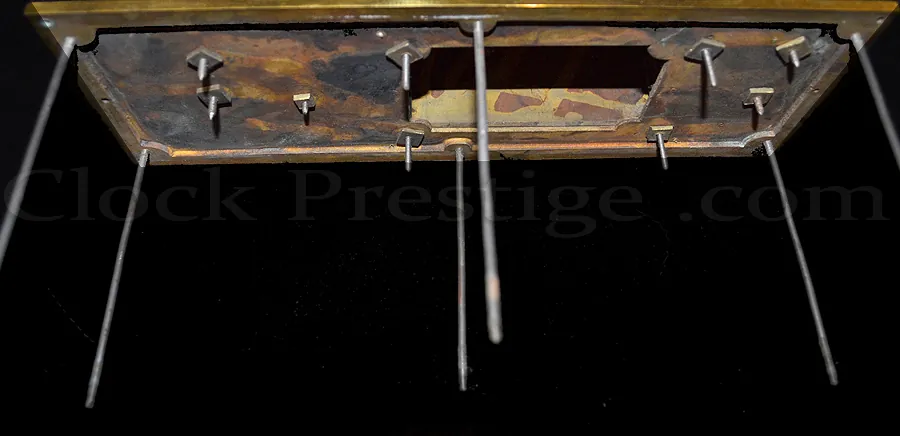
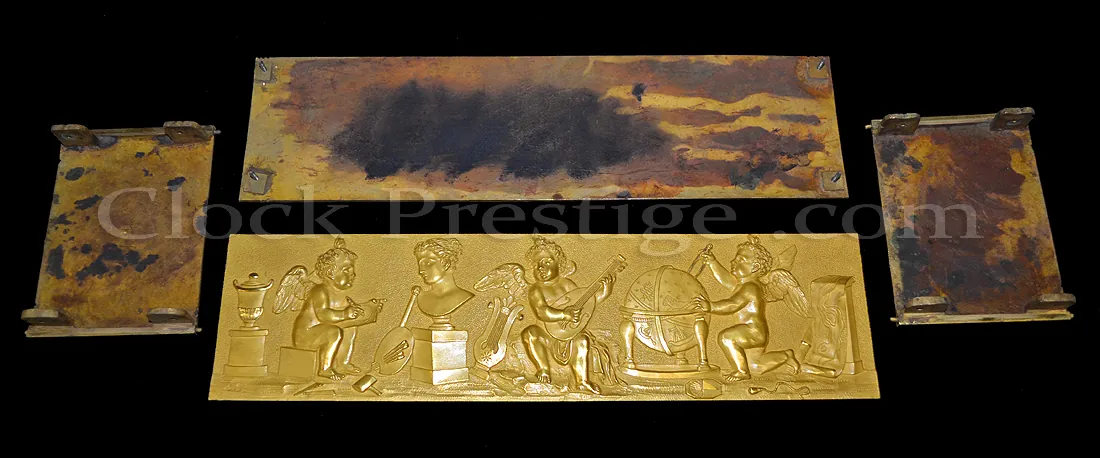
The rectangular base consists of three parts, held together by six threaded rods secured with nuts. This ensures that the edges meet precisely, without a gap. The rods and nuts you see are the originals.

The centre section of the base has another distinctive feature: it is itself assembled from four elements. This unusual method is found in about one clock in ten. In most clocks, this section is made in a single piece.

The sculptor’s work

The figure reveals how it was made

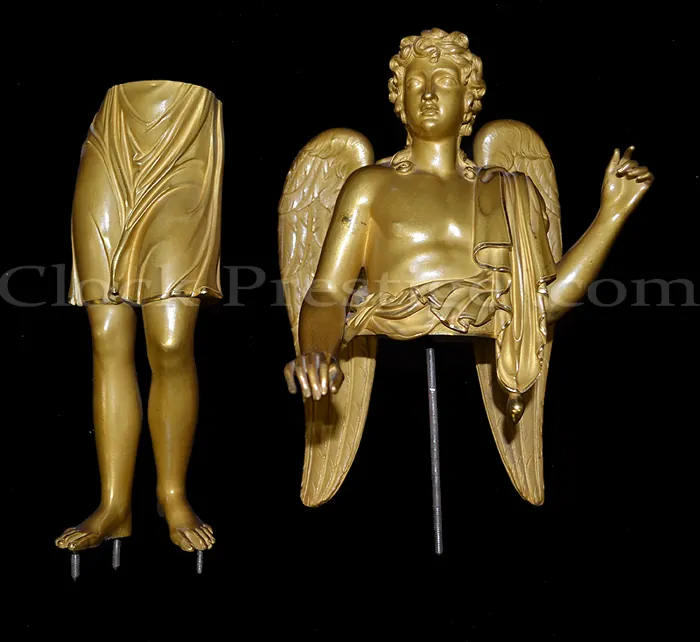
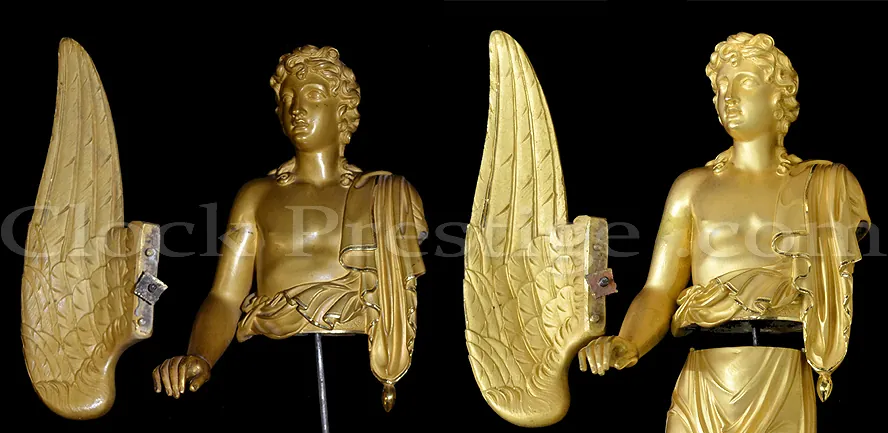
Until the first half of the 19th century, figures were made in several pieces to refine the modelling, achieve a more lifelike result and save raw material. The quality of the finished work also owes much to this ingenuity of construction.

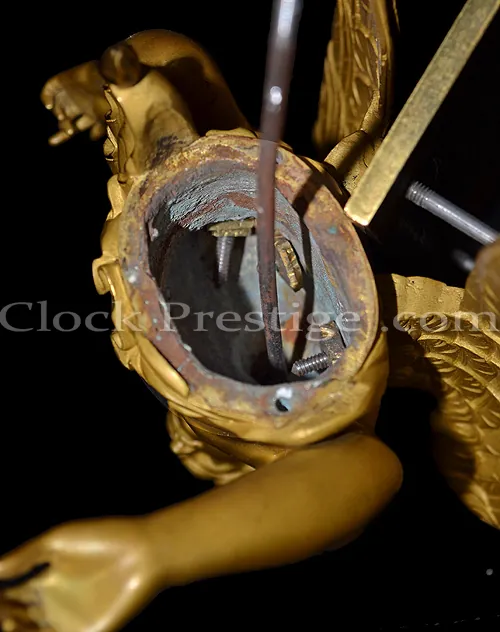
Dismantling the figure begins by separating it into two parts. The nut that holds them together is concealed beneath the garment, behind the upper legs.

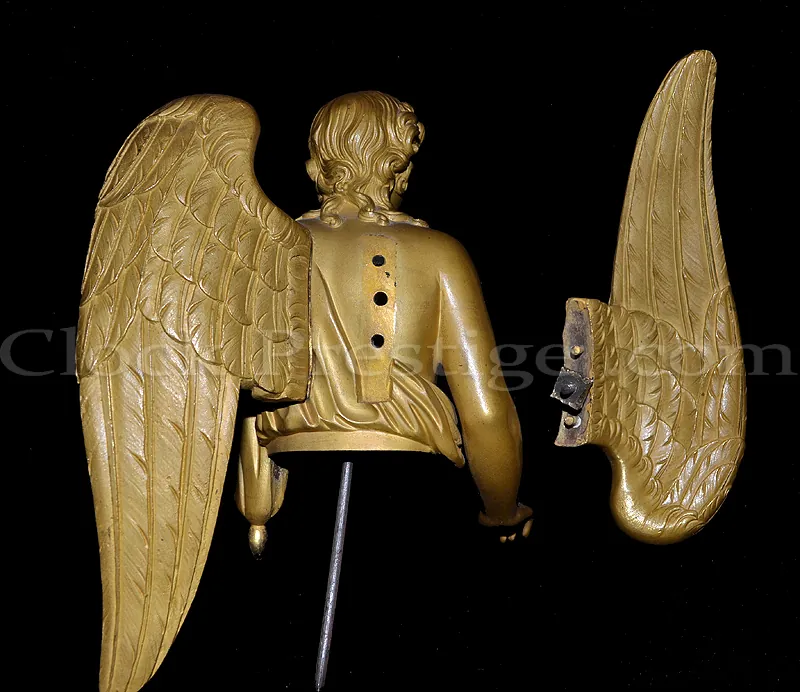
Inside the torso, three more nuts secure the wings and the right arm. This gives an idea of the patience and time required both to dismantle and to reassemble the figure.

The ingenuity of the joints

Six pieces, one silhouette

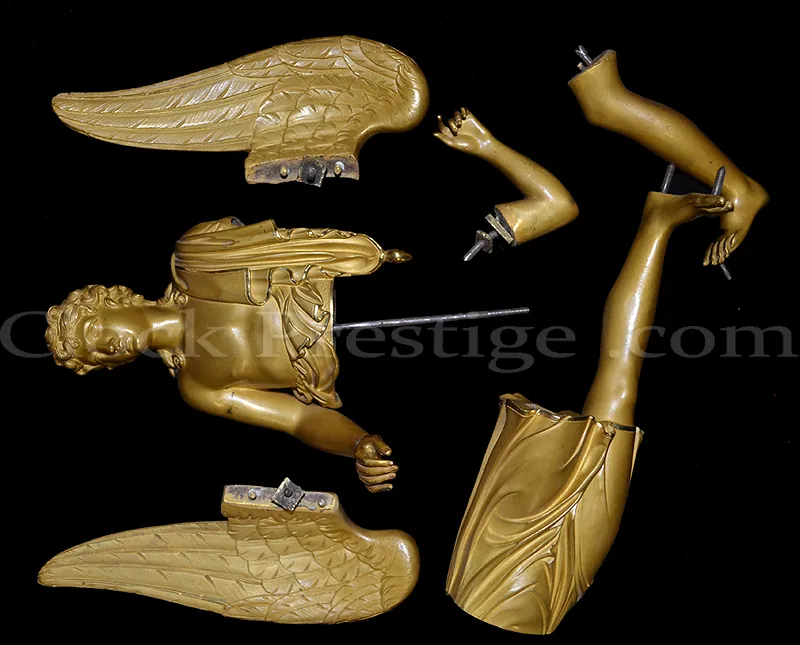
The joints have locating pins that guide the components into position and hold them firmly. These guides ensure that each piece returns to precisely the right place.

This figure, which looks as though it were sculpted in one piece, turns out to be made of six. Once assembled, the pieces form a silhouette whose joints are barely apparent.

The decorative elements

Recovering the fineness of the details

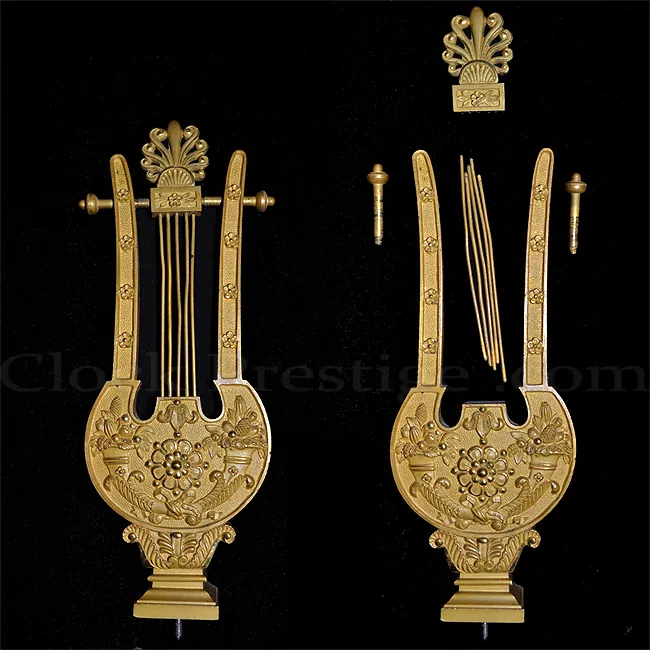
Dismantling the piece completely also gives us access to its most delicate decorative elements. We can then straighten the strings of this lyre, which seemed to have lost its voice, and restore the harmony of its lines.

The fittings around the movement

From the dial to the movement

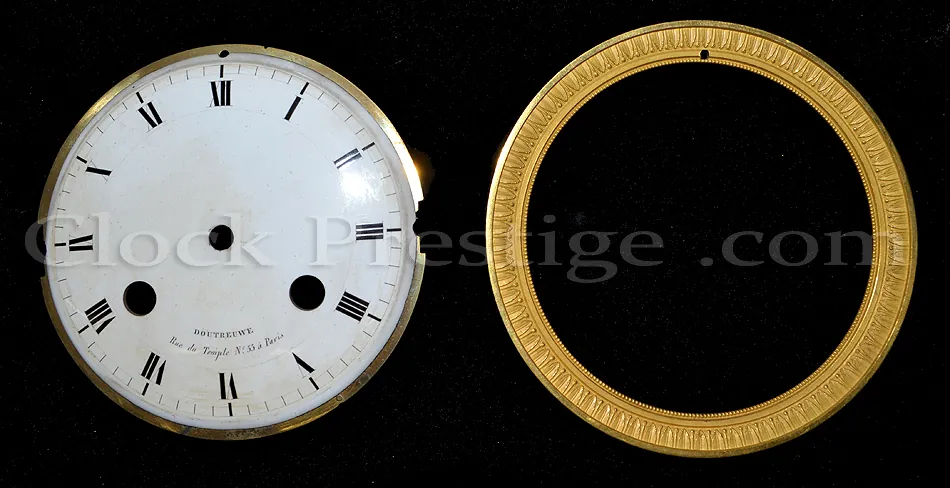
The dial fits into a bronze bezel, to which it is secured by three screws. The enamel dial is mounted on a smooth plate. This assembly is then secured to the movement.

Cleaning and passing on a legacy

Revealing the lustre, preserving the legacy

Each component is then carefully cleaned, right into its smallest recesses, to recover a clean, even surface. This is when the state of the gilding and the play of contrasts between its matt and polished areas become apparent.

When carried out according to the traditions of the craft, this cleaning brings out the full beauty and nobility of the mercury-gilt bronze.

Through this work I also hope to share an appreciation of how fortunate we are still to be able to admire this exceptional heritage, handed down to us through the ingenuity and skill of its makers.

01of08

Questions

We take full responsibility for delivery/transportation

In 15 years of mail-order sales, we have sent hundreds of parcels around the world. Thanks to this experience, we can ship each object to your chosen destination at our own risk.

Satisfied or your money back.

Our customers’ satisfaction remains our priority.
You have 14 days from receipt of your object to request a return. To do so, please email us at contact@clockprestige.com.
We cover the return postage and will email you a prepaid return label.
Once we receive the object, we will refund you within 48 hours, either to your bank card or by bank transfer.

Ethical charter

Our items mainly stem from the inheritance of objects, preciously looked after over numerous generations. There is a stringent selection process for each object ensuring perfect authenticity and the optimal amount of gilding

Refurbishment vs Restoration – Our expertise

We do not use the term “restoration”, which refers to a transformation or major repair that may alter the authenticity or original appearance of a piece.
We dismantle each object completely and clean it part by part. Our cleaning technique brings back the lustre without damaging the gold.
We reassemble the piece, returning each component, nut and screw to its original position. We then check that it is level, symmetrical and flat, among other things.

The clock movement receives a complete overhaul. It is dismantled in full, and every part is cleaned and polished. The duration of this work affects the finish. We like to obtain a bright lustre in keeping with the gilding of the piece.
Rebushing is a particularly important step. To remedy wear from years of use, we fit a bush in each pivot hole that has worn out of shape, restoring the strength and quality of the gearing. Once the movement is fully reassembled, it undergoes a long period of testing to check its running and the striking of the hours and half-hours.

Means of payment

  • Accepted cards: Visa, MasterCard, American Express, JCB, Discover and Diners Club.
  • Bank transfer: you can send us a copy of your transfer order so we can prepare your order sooner.

Delivery times

Upon dispatch of your order, you will be sent a parcel tracking number by email.

Delivery anywhere in the world.

France:
- Clocks: 3 days preparation work + 1 day for delivery - Total: 4 business days
- Decorative objects: 1 day preparation work + 1 day for delivery - Total: 2 business days

Europe
- Clocks: 3 days preparation work + 3 days for delivery - Total: 6 business days
- Decorative objects: 1 day preparation work + 3 days for delivery - Total: 6 business days

Other countries
- Clocks: 3 days preparation work + 3-8 days for delivery
- Decorative objects: 1 days preparation work + 3-8 days for delivery

Assistance with operating your clock

You will receive—by email and a paper version—an explanatory document containing all the necessary instructions and recommendations for operating your clock.
We also provide assistance over the phone to guide you through the start-up procedure. Of course, we will continue to be available—by both telephone and email—to answer any questions you may have.
For calls in German or English, please make an appointment first via email, providing us with your telephone number, and the date and time you wish to contact us. Contact.

Certificate and Invoice

Every purchase comes with a certificate of authenticity and an invoice
High quality certificate of authenticity printed on photo paper with text and photos providing all the information concerning your object. Detailed invoice indicating the price paid for the object.