A Louis XVI period portico clock in a so-called "half-moon" shape, made at the end of the 18th century, crafted from white marble and finely chased bronze, mercury-gilded with gold. The piece presents a particularly elegant and balanced design. The dial is stamped with the name of the clockmaker "Hilgers à Paris," listed in Tardy's dictionary of French clockmakers. Even rarer, the name of the enameller "Barbichon – 1786," also listed in Tardy, appears under the numeral VI, accompanied here by the date of production—a highly sought-after detail attesting to the piece's authenticity and quality of execution.
The upper section is surmounted by a covered white marble vase, in an antique style, resting on a pedestal. The lid is topped with a finial in the form of a flaming flame, a recurring symbol in the decorative vocabulary of the period, evoking sacred fire and permanence. The rim of the vase is adorned with a simulated gallery of finely chiseled pearls, embellished with cascading chains held by small circular medallions and terminating in teardrop pendants. This delicate ornamentation lends a refined sense of movement to the whole.
The circular dial is set within an imposing wreath of intertwined laurel leaves. Each leaf is finely veined and delicately modeled, creating a particularly vibrant interplay of reliefs. The laurel, an emblem of victory and eternity, is a recurring motif in the Louis XVI repertoire. The domed white enamel dial, protected by a glass cover, features a railway-style minute track and exquisitely refined black Roman numerals. The openwork and chiseled hands adopt an elegant form inspired by the plant world. The clock's body rests on an…
A Louis XVI period portico clock in a so-called "half-moon" shape, made at the end of the 18th century, crafted from white marble and finely chased bronze, mercury-gilded with gold. The piece presents a particularly elegant and balanced design. The dial is stamped with the name of the clockmaker "Hilgers à Paris," listed in Tardy's dictionary of French clockmakers. Even rarer, the name of the enameller "Barbichon – 1786," also listed in Tardy, appears under the numeral VI, accompanied here by the date of production—a highly sought-after detail attesting to the piece's authenticity and quality of execution.
The upper section is surmounted by a covered white marble vase, in an antique style, resting on a pedestal. The lid is topped with a finial in the form of a flaming flame, a recurring symbol in the decorative vocabulary of the period, evoking sacred fire and permanence. The rim of the vase is adorned with a simulated gallery of finely chiseled pearls, embellished with cascading chains held by small circular medallions and terminating in teardrop pendants. This delicate ornamentation lends a refined sense of movement to the whole.
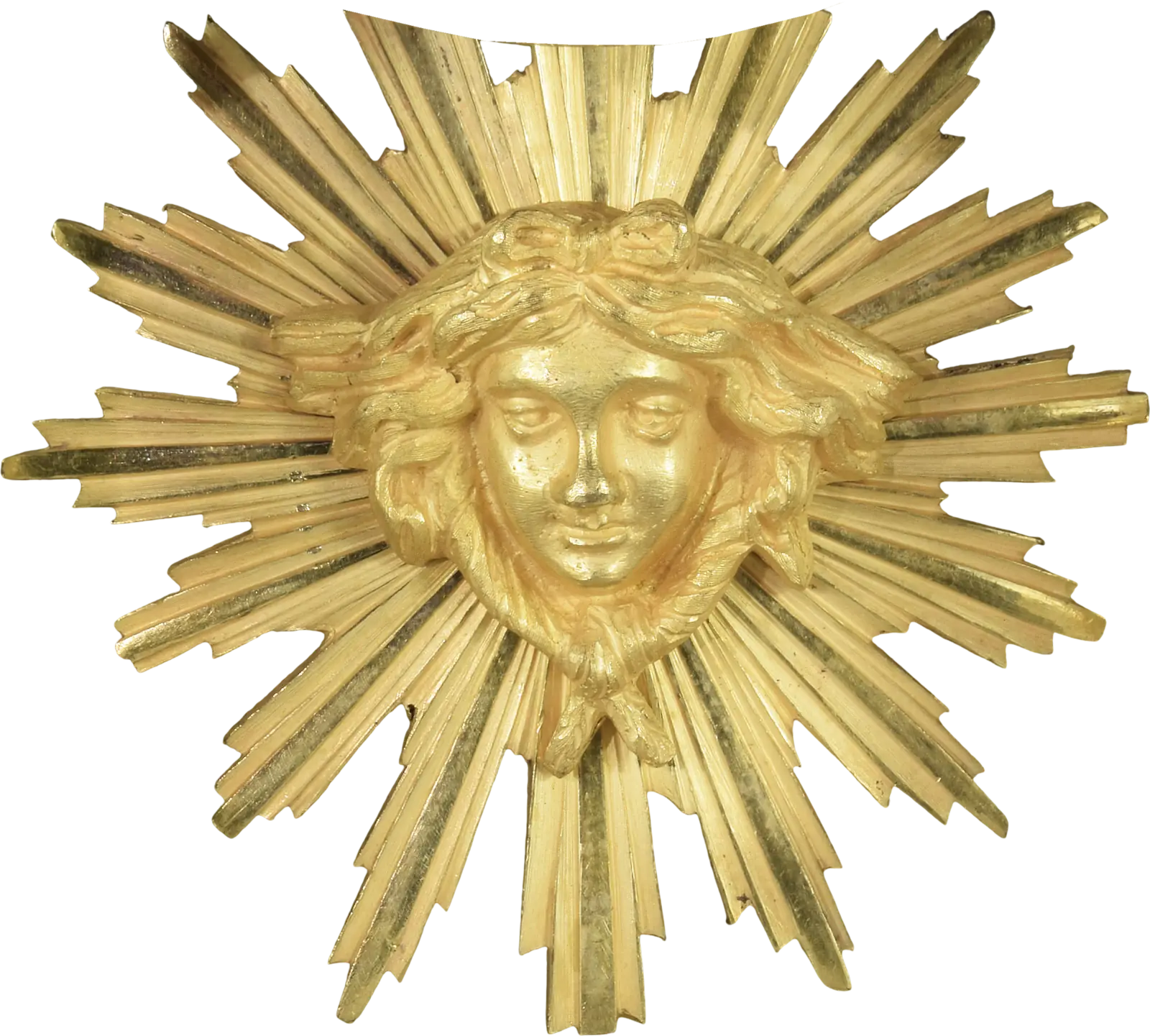
The circular dial is set within an imposing wreath of intertwined laurel leaves. Each leaf is finely veined and delicately modeled, creating a particularly vibrant interplay of reliefs. The laurel, an emblem of victory and eternity, is a recurring motif in the Louis XVI repertoire. The domed white enamel dial, protected by a glass cover, features a railway-style minute track and exquisitely refined black Roman numerals. The openwork and chiseled hands adopt an elegant form inspired by the plant world. The clock's body rests on an architecturally designed, crescent-shaped base composed of four cylindrical columns of white marble. These are crowned and finished with finely molded capitals and bases. Between the columns, new garlands of suspended chains unfold, punctuated by tapered pendants. At the center hangs a solar medallion depicting a radiant face, a motif directly inspired by classical iconography and the Neoclassical decorative repertoire. Beneath this solar mascaron is a radiant element in gilt bronze evoking a rosette. The upper terrace and lower base are highlighted with particularly regular beaded friezes, while the base's band features a rich openwork frieze of finely chiseled scrolls, acanthus leaves, and volutes.
The whole rests on small, flattened feet in gilt bronze, completing the overall balance of the composition. With its clean lines, symmetrical design, and richly chiseled decoration, this clock elegantly illustrates the refinement of Parisian craftsmanship from the late 18th century. It stands as a remarkable testament to the combined expertise of bronze workers, marble workers, clockmakers, and enamelers active during the reign of Louis XVI.
Original movement intact and unaltered, with silk-thread suspension. Striking on the hours and half-hours on an antique bell, producing a clear and authentic tone.
This website uses cookies to ensure you get the best experience on our website.
Functional Always active
The technical storage or access is strictly necessary for the legitimate interest purpose of enabling the use of a specific service explicitly requested by the subscriber or user, or for the sole purpose of carrying out the transmission of a communication over an electronic communications network.
Preferences
The technical storage or access is necessary for the legitimate purpose of storing preferences that are not requested by the subscriber or user.
Statistiques
The technical storage or access that is used exclusively for statistical purposes.Le stockage ou l’accès technique qui est utilisé exclusivement à des fins statistiques anonymes. En l’absence d’une assignation à comparaître, d’une conformité volontaire de la part de votre fournisseur d’accès à internet ou d’enregistrements supplémentaires provenant d’un tiers, les informations stockées ou extraites à cette seule fin ne peuvent généralement pas être utilisées pour vous identifier.
Marketing
The technical storage or access is required to create user profiles in order to send advertising, or to track the user on a website or across several websites for similar marketing purposes.

 Discover this piece
 Discover this piece
 Discover this piece
 Discover this piece
 Discover this piece
 Discover this piece
 Discover this piece
 Discover this piece
 Discover this piece
 Discover this piece
 Discover this piece
 Discover this piece
 Discover this piece
 Discover this piece
 Discover this piece