This elegant portico clock, made around 1850 during the Charles X period, features an architectural mahogany-veneered case richly enhanced with mercury-gilt ormolu. Its movement, stamped “Marti et Cie”, was produced by a French clockmaking firm listed in Tardy’s renowned Dictionnaire des horlogers français, adding further interest to this beautiful piece. The mahogany veneer has been carefully finished with a hand-applied French polish, enhancing the depth and warmth of the wood while providing a remarkable sheen, an elegant contrast with the gilded bronzes, and lasting protection.
The composition elegantly follows the principles of portico architecture, inspired by Antiquity. Four cylindrical mahogany columns, with slender, carefully polished shafts, rest on square gilt-bronze bases and are crowned with richly chased capitals decorated with geometric motifs and stylised foliage. They support a monumental entablature topped by a rectangular pediment, whose cornices are adorned with an elegant gadrooned frieze. At the centre, the white enamel dial is marked with black Roman numerals and fitted with fine gilt-bronze hands. It is framed by a spectacular gilt-bronze surround, profusely decorated with scrolling foliage, volutes and vegetal motifs. Beneath the dial is a remarkable openwork pendulum, dominated by a female mask and enriched with scrolls, palmettes and Neoclassical motifs, creating a particularly decorative ensemble. The imposing and perfectly proportioned base repeats the same gadrooned ornament along its borders and rests on four small feet, while the richness of the gilt-bronze decoration harmoniously contrasts with the sobriety and depth of the…
This elegant portico clock, made around 1850 during the Charles X period, features an architectural mahogany-veneered case richly enhanced with mercury-gilt ormolu. Its movement, stamped “Marti et Cie”, was produced by a French clockmaking firm listed in Tardy’s renowned Dictionnaire des horlogers français, adding further interest to this beautiful piece. The mahogany veneer has been carefully finished with a hand-applied French polish, enhancing the depth and warmth of the wood while providing a remarkable sheen, an elegant contrast with the gilded bronzes, and lasting protection.
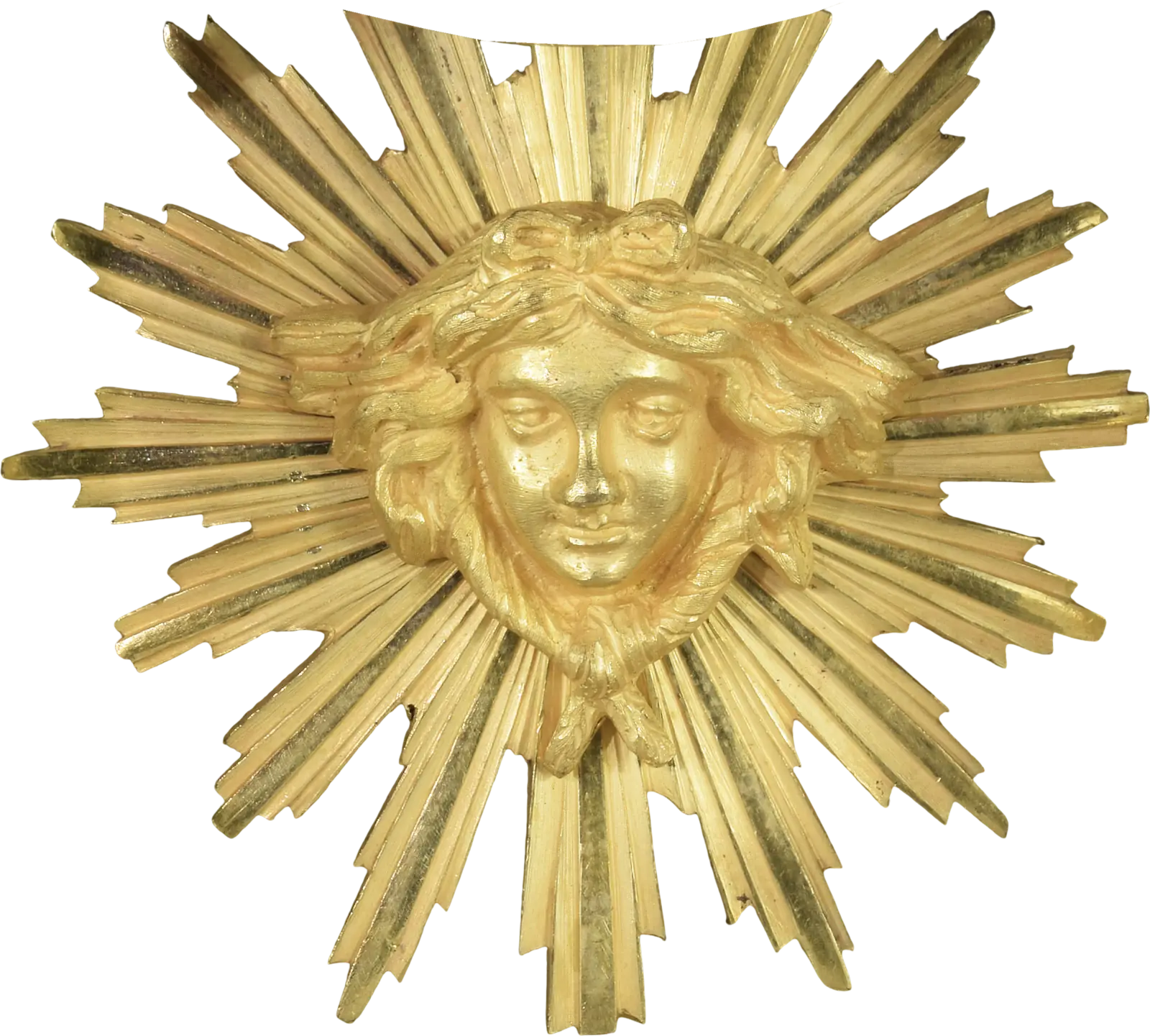
The composition elegantly follows the principles of portico architecture, inspired by Antiquity. Four cylindrical mahogany columns, with slender, carefully polished shafts, rest on square gilt-bronze bases and are crowned with richly chased capitals decorated with geometric motifs and stylised foliage. They support a monumental entablature topped by a rectangular pediment, whose cornices are adorned with an elegant gadrooned frieze. At the centre, the white enamel dial is marked with black Roman numerals and fitted with fine gilt-bronze hands. It is framed by a spectacular gilt-bronze surround, profusely decorated with scrolling foliage, volutes and vegetal motifs. Beneath the dial is a remarkable openwork pendulum, dominated by a female mask and enriched with scrolls, palmettes and Neoclassical motifs, creating a particularly decorative ensemble. The imposing and perfectly proportioned base repeats the same gadrooned ornament along its borders and rests on four small feet, while the richness of the gilt-bronze decoration harmoniously contrasts with the sobriety and depth of the mahogany.
Through its balanced architecture, noble materials and finely executed decoration, this portico clock is a beautiful example of French Neoclassical aesthetics. The presence of the movement signed “Marti et Cie”, the richness of the gilded bronzes and the particularly attractive preservation of the mahogany veneer further enhance its historical and aesthetic appeal. Its refined decoration, architectural silhouette and striking contrast between the deep mahogany and luminous gilding give it a remarkable presence. Elegant and timeless, it would naturally complement a classical, Empire or Neoclassical interior, where it can be appreciated both as a fine timepiece and as a true work of decorative art.
The original mechanism remains unchanged, striking the hours and half-hours on an antique bell.
This website uses cookies to ensure you get the best experience on our website.
Functional Always active
The technical storage or access is strictly necessary for the legitimate interest purpose of enabling the use of a specific service explicitly requested by the subscriber or user, or for the sole purpose of carrying out the transmission of a communication over an electronic communications network.
Preferences
The technical storage or access is necessary for the legitimate purpose of storing preferences that are not requested by the subscriber or user.
Statistiques
The technical storage or access that is used exclusively for statistical purposes.Le stockage ou l’accès technique qui est utilisé exclusivement à des fins statistiques anonymes. En l’absence d’une assignation à comparaître, d’une conformité volontaire de la part de votre fournisseur d’accès à internet ou d’enregistrements supplémentaires provenant d’un tiers, les informations stockées ou extraites à cette seule fin ne peuvent généralement pas être utilisées pour vous identifier.
Marketing
The technical storage or access is required to create user profiles in order to send advertising, or to track the user on a website or across several websites for similar marketing purposes.

 Discover this piece
 Discover this piece
 Discover this piece
 Discover this piece
 Discover this piece
 Discover this piece
 Discover this piece
 Discover this piece
 Discover this piece
 Discover this piece
 Discover this piece
 Discover this piece
 Discover this piece
 Discover this piece
 Discover this piece